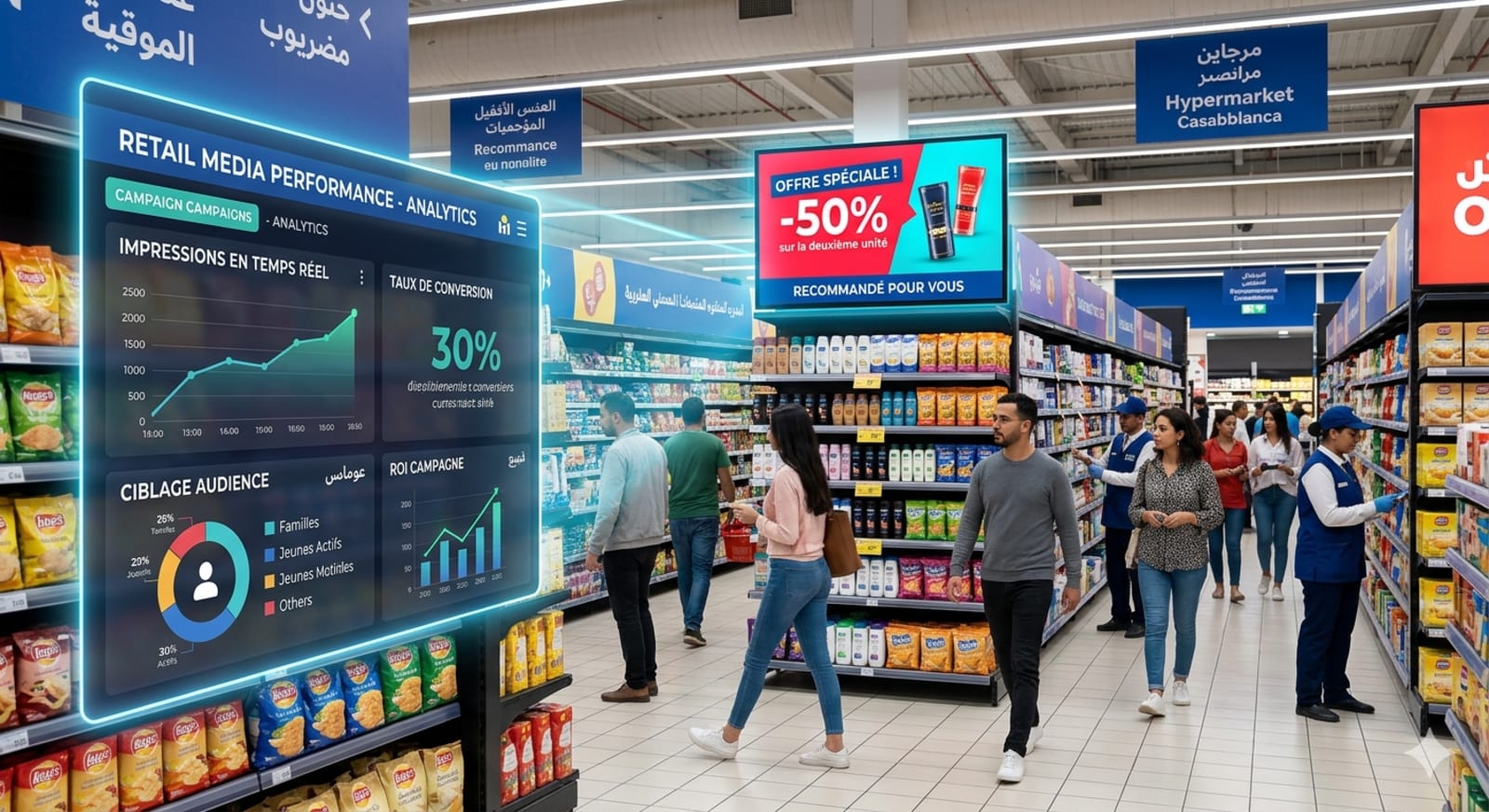
Retail Media in Morocco refers to major supermarket chains (such as Marjane, Label'Vie, and Carrefour) leveraging their customer data, along with their physical and digital store traffic, to sell highly targeted advertising spaces to partner brands.
A Silent Revolution on Moroccan Shelves
Five years ago, when a consumer goods brand wanted to reach customers of a Moroccan retail chain, it had two options: pay for a physical endcap display in-store, or negotiate a promotional budget to fund price discounts.
While these levers still exist, something has fundamentally changed in how advanced retailers approach their relationships with partner brands.
This shift is called Retail Media, and it is reshaping the digital advertising landscape in Morocco.
What Exactly Is Retail Media?
Retail Media refers to a retailer's ability to monetize its own audience by allowing partner brands to run targeted advertisements across its digital and physical channels.
Simply put, a retailer like Marjane or Label'Vie sits on a massive customer database. They know what their customers buy, how often, in which stores, and their average basket size. This insight holds immense commercial value for brands looking to reach these exact consumers.
Retail Media turns this insight into advertising inventory. Brands no longer pay for generic visibility; they pay to reach the exact customers who already buy in their category or show a high propensity to do so.
It is the difference between placing a billboard on the side of a highway and displaying a personalized message directly to a customer who just purchased your competitor's product last week.
Why Data Is at the Core of the System
A Retail Media program without a solid data architecture is not Retail Media—it is just traditional advertising with a modern name.
The real value of Retail Media relies on three core data capabilities that retailers must build before offering anything to partner brands.
The first is a unified customer view. This means being able to reconcile checkout purchases, mobile app behavior, promotional email interactions, and loyalty card data into a single, actionable customer profile. Without this unified view, targeting remains speculative.
The second is dynamic segmentation. Audiences are only useful if they can be defined with precision and updated in real time. A customer who bought a baby product this month enters a relevant segment for childcare brands. In six months, their behavior will change, and the segmentation must adapt accordingly.
The third is measuring incrementality. This is the holy grail of Retail Media: being able to prove to a partner brand that their ad spend generated actual additional sales, rather than simply reaching customers who would have bought the product anyway. This measurement requires an analytical infrastructure that few Moroccan retailers have built so far.
What We Observed with Greentek Media
Our collaboration with Greentek Media on their Retail Media marketing strategy allowed us to closely observe the practical challenges faced by players looking to build this type of program in Morocco.
The first observation is that the data always exists. Retailers have accumulated massive volumes of data over the years. The issue is not quantity; it is fragmentation and quality.
POS data sits in one system, loyalty data in another, and digital data in a third. Historically, no bridge had been built to make them talk to each other.
The second observation is that marketing and data teams operate differently. Marketing teams think in campaigns, targets, and messaging. Data teams think in schemas, pipelines, and models. Building a successful Retail Media program requires these two worlds to align and collaborate around shared goals.
Retail Media Formats in Morocco
Retail Media goes far beyond digital banner ads on an e-commerce site. It covers a broad spectrum of formats and channels.
Digital formats include sponsored banners on mobile apps and websites, targeted emails sent to specific buyer segments, personalized push notifications, and retargeting campaigns built on the retailer's first-party data.
In-store formats include digital screens with content personalized based on the profile of shoppers present, connected endcaps, and targeted couponing or sampling at checkout based on purchase history.
Measurement formats—often overlooked but essential—include incrementality studies, purchase panels, and real-time performance dashboards accessible to partner brands.
Obstacles to Overcome for Moroccan Retailers
Building a robust Retail Media program in Morocco requires overcoming several practical hurdles.
The first is regulatory. Moroccan Law 09-08 on personal data protection strictly regulates the use of customer data for advertising. Any Retail Media program must be built from the ground up with compliance in mind, featuring clear consent mechanisms and rigorous data governance.
The second is organizational. Retail Media introduces a new type of relationship between retailers and suppliers. It is no longer just a buyer-seller dynamic; it is a media relationship that requires new skills, new processes, and often dedicated teams.
The third is technological. Monetizing an audience professionally requires a modern tech stack: a Customer Data Platform (CDP), a campaign management platform, and advanced measurement and reporting tools. These are significant investments that must be planned for the long term.
The Right Time to Act
Amazon built its Retail Media business over a decade, and it now generates tens of billions of dollars in annual revenue. In Europe, major retailers like Carrefour and Leclerc launched their media networks four to five years ago and are now reaping the rewards of those investments.
In Morocco, the market is still in its foundational phase. Retailers investing today in their data architecture and Retail Media program structure will secure a competitive advantage that will be difficult for others to close in the next three to five years.
The window of opportunity is open, but it will not stay open forever.
Conclusion
Retail Media is not a distant Western trend that will take a decade to reach Morocco. It is already here, driven by the rapid digitization of consumer behavior and growing pressure on brands seeking alternatives to traditional ad platforms where costs are rising and precision is declining.
Retailers building their data infrastructure and targeting capabilities today are positioning themselves to transform their relationships with brand partners. Those who wait will watch their competitors capture this value instead.
Data is the new shelf space. And just like physical shelves, it belongs to those who build it.
