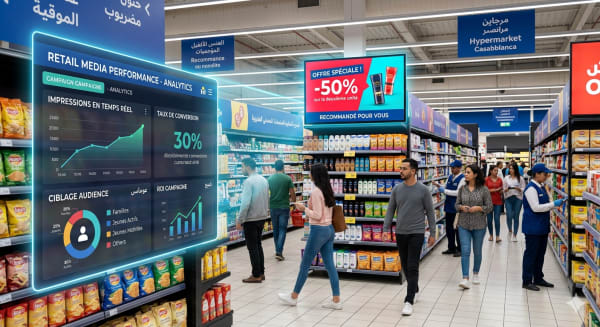
Analytical CRM analyzes customer behavior to segment and personalize (who are my customers, what are they worth?), while operational CRM manages daily interactions (calls, emails, meetings). Both are complementary.
The Marketing Meeting That Goes in Circles
A marketing director at a Moroccan retail chain recently shared a scenario we recognize instantly. Her company had invested in Salesforce two years prior. The tool was properly deployed, and sales teams used it daily to manage opportunities and contacts. Adoption rates were strong.
But when executive management asked her to answer simple questions, everything fell apart.
Who are our most profitable customers? Which segments generate the most value over twelve months? Which customers are at risk of churning in the next three months? Which acquisition channel produces customers with the best lifetime value?
Her CRM could not answer any of these questions. Not because Salesforce is a bad tool, but because she was using an operational CRM to answer questions that require an analytical CRM.
Two Tools, Two Fundamentally Different Logics
The confusion between operational CRM and analytical CRM is one of the most common pitfalls in Moroccan marketing departments. It leads to costly, poor decisions and misdirected investments.
An **operational CRM** is a tool for managing daily interactions with customers and prospects. It records contacts, opportunities, sales activities, sent emails, and phone calls. It helps sales teams organize their work, track pipelines, and stay on top of tasks. Salesforce, Microsoft Dynamics, and HubSpot are operational CRMs.
An **analytical CRM** is a tool for analyzing and understanding customer behavior. It aggregates transactional, behavioral, and relational data to produce insights into who your customers are, how they behave, what they are worth, and how they evolve over time. It answers the strategic questions that the operational CRM records but cannot analyze.
These two tools are not in competition; they are complementary. The operational CRM produces the data. The analytical CRM transforms it into actionable knowledge.
What Analytical CRM Enables in Practice
When we deploy an analytical CRM for a client, the first few weeks are always eye-opening. Marketing teams discover realities about their customer base that they sometimes suspected but could never quantify, alongside other insights that surprise them completely.
**Customer value segmentation** is the first step. Not all customers are worth the same, and this difference is rarely proportional to intuition. In retail, we consistently observe that twenty percent of customers generate sixty to seventy percent of revenue. Identifying these customers precisely, understanding their characteristics, and building specific strategies to retain and grow them is impossible without analytics.
**Churn risk modeling** is the second high-impact use case. A customer about to leave sends signals before they actually depart. Their purchase frequency drops. Their average basket value decreases. Their engagement with marketing communications fades. An analytical model detects these signals, allowing you to intervene before the customer is lost.
**Sales attribution by channel** is the third area that marketing teams often discover with surprise. Which channel actually contributed to a sale when a customer was touched by an email campaign, a Meta ad, and a store visit before buying? Without analytics, the answer is arbitrary. With a well-configured analytical CRM, it becomes measurable.
The Case of Label'Vie and Marjane
Our experience with Label'Vie and Marjane Holding in the retail sector concretely illustrates the value of a well-structured analytical CRM approach.
In both cases, the initial challenge was identical: large customer bases, rich transactional data accumulated over years, and an analytical capability that did not allow them to truly leverage this wealth of information.
The work began by building a unified customer data warehouse, reconciling POS data, loyalty card data, mobile app data, and marketing campaign data. This technical foundation is the indispensable prerequisite for any serious customer analytics.
On top of this foundation, we built segmentation models, purchase propensity scores by category, and churn risk alerts. For the first time, marketing teams could personalize their communications at scale, targeting precise segments with messages tailored to their actual behavior.
The most tangible result was not a single metric, but a cultural shift. Teams stopped talking about their customers in generic terms and started discussing specific segments with documented behaviors and differentiated strategies.
The Four Components of an Effective Analytical CRM
An analytical CRM is not a software package you buy and install. It is an architecture that combines four key components:
1. **Unified Data:** All customer interactions—transactional, behavioral, and relational—must converge into a single repository. Without this unification, analytics remain partial and potentially misleading.
2. **Customer Data Model:** This defines how a customer is represented in the analytical system, what their attributes are, how their value is calculated, and how they are segmented. This model is specific to each business and must be co-designed with business teams.
3. **Algorithms and Analytical Models:** Segmentation, scoring, churn prediction, and product recommendations. These models transform raw data into actionable insights. Their complexity must match the capabilities of the teams using them.
4. **Actionable Interfaces:** The insights produced by the analytical CRM must be accessible to marketing teams in a format that allows them to take immediate action—whether by launching a targeted campaign, alerting a sales rep, or personalizing an offer.
Why Many Moroccan Companies Invest Poorly in CRM
We observe two recurring errors in CRM projects in Morocco.
The first is overloading the operational CRM with analytical features it was never designed to support. Teams add reports, dashboards, and exports until the tool becomes slow, complex, and unreliable because the operational model was not built for heavy analysis.
The second is investing in an analytical CRM without having a properly populated operational CRM. Analytics can only produce what the data allows. If the data in the operational CRM is incomplete, poorly entered, or inconsistent, the analytical CRM will only amplify these issues rather than solve them.
The correct sequence is clear: first, build a well-configured and highly adopted operational CRM. Ensure the quality and completeness of the data it produces. Then, build your analytics on top of this solid foundation.
How to Start If You Are Beginning from Scratch
If your organization does not yet have an analytical CRM and you want to build one, here is the roadmap we systematically recommend:
* **Audit the quality of your existing CRM data:** What percentage of your customer profiles are complete? How consistent is your CRM data with your transactional data? Without this assessment, you will not know what foundation you are building on.
* **Define the top three analytical questions you need to answer:** Not twenty questions—just three. These questions will guide the architecture of your first version and prevent you from building an overly complex system that never gets used.
* **Identify the data sources you need to unify:** CRM, ERP, POS data, digital touchpoints. Map these sources and evaluate the feasibility of their integration.
* **Build a limited but operational first version in eight to twelve weeks:** Get it adopted, measure its value, and then scale.
Conclusion
The distinction between operational and analytical CRM is not a technical detail. It fundamentally structures how an organization understands and serves its customers.
Moroccan companies that have built this analytical capability on top of their customer base hold a real competitive advantage. They make better marketing decisions, allocate budgets more efficiently, retain their best customers longer, and acquire new ones more intelligently.
Customer knowledge is no longer an optional advantage in a Moroccan market that is rapidly growing and becoming more sophisticated. It is a prerequisite for sustainable competitiveness.