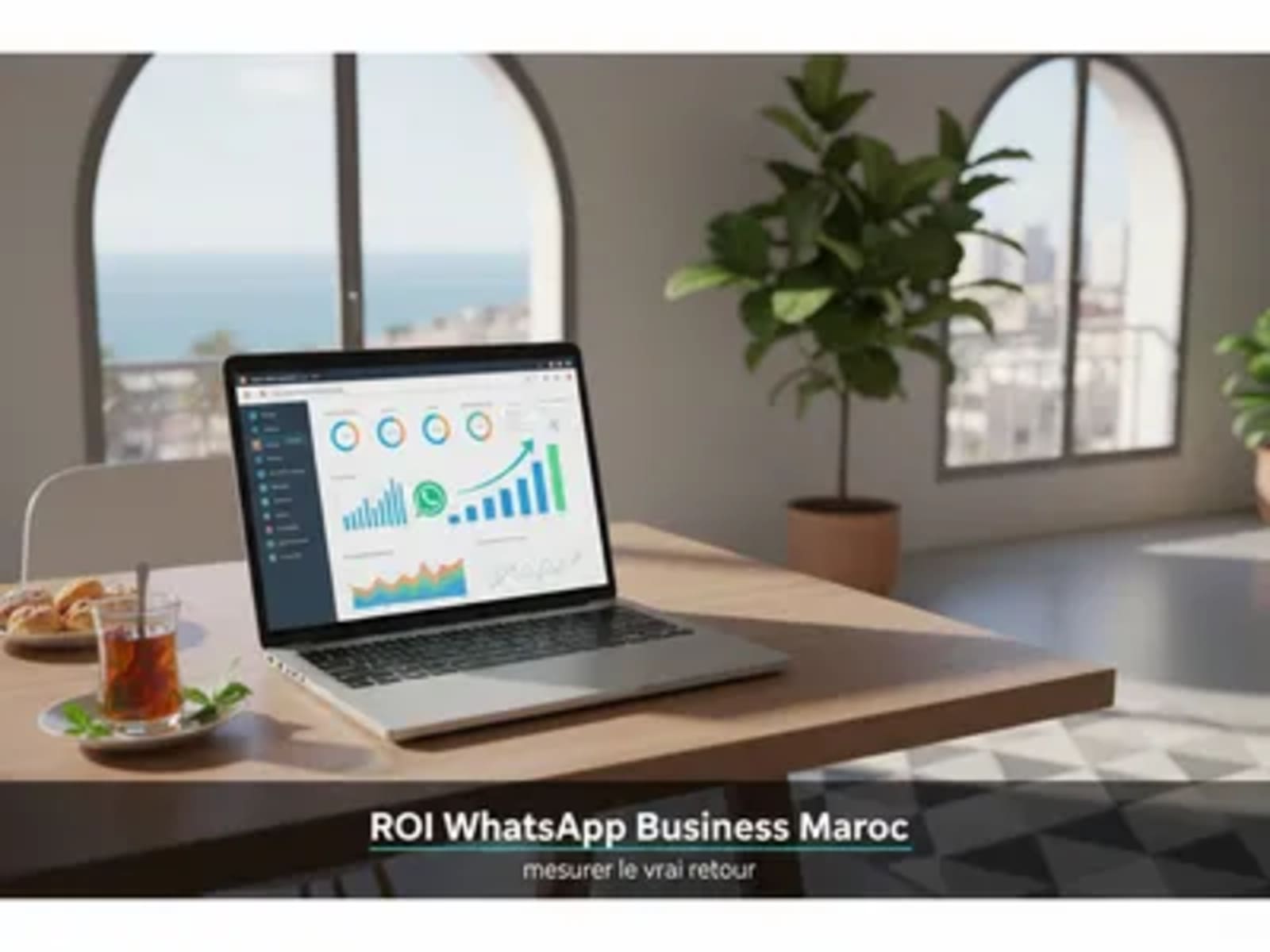
To measure the ROI of WhatsApp Business in Morocco, you must connect the official WhatsApp API to your CRM and Point of Sale (POS) systems. Use unique UTM parameters on action buttons for web traffic, and individual QR codes or promo codes to track physical in-store sales. ROI is calculated by dividing the attributed revenue by the total cost of the 24-hour conversation sessions, platform fees, and human management costs.
Thousands of Messages Sent, No Reliable Figures
In the marketing departments of Casablanca and Rabat, the end-of-month assessment is often the same. Tens of thousands of messages have been broadcast via WhatsApp campaigns to announce a promotion, the launch of a new real estate project, or a clearance sale. Delivery reports show exceptional open rates, often hovering between 80% and 90%. Yet, when presenting the financial report to the executive committee, the marketing director finds themselves unable to prove the actual impact of these actions on overall revenue. This lack of visibility turns a high-potential tool into an unmanaged cost center.
The Moroccan market has massively adopted instant messaging as its preferred communication channel. For a major retail brand like Marjane Holding or Label'Vie, or for a real estate developer like Chaabane Immobilier, the opportunity to reach consumers directly on their phones is immense. However, sending messages without rigorous tracking creates an illusion of performance. All too often, the vanity of read receipts is confused with actual commercial effectiveness. The real challenge no longer lies in sending the campaign, but in the ability to track the customer journey from the first click on the app to the final transaction at the cash register or in-branch.
What WhatsApp Business Actually Allows You to Track
To move away from guesswork, companies must leverage the advanced technical features of the WhatsApp Business API. Unlike the consumer app or the standard Business version on smartphones, the official API offers measurable touchpoints. Each interaction can be enriched with specific parameters to enable precise tracking. The first level of traceability relies on the use of personalized links and dynamic call-to-action buttons containing unique UTM parameters. When a user clicks a button to visit a product page or book an appointment, their journey on the company's website is tracked from end to end.
Beyond the simple click, the platform allows you to measure actual response rates and the resolution time of conversations by customer service agents or chatbots. By integrating the WhatsApp API with a Customer Relationship Management (CRM) tool or a Customer Data Platform (CDP), businesses can assign a unique identifier to each phone number. This technical bridge makes it possible to know exactly which message triggered a specific interaction. This shifts the analysis from mass broadcasting to detailed behavioral analysis, where every stage of the messaging conversion funnel is quantified and optimized.
Linking a Conversation to an In-Store Sale
In Morocco, a major portion of commerce still takes place physically in retail outlets, showrooms, or sales branches. The great challenge of conversational marketing is connecting the virtual discussion to the physical purchase. To solve this equation, using unique promotional codes and dynamic QR codes is the most effective solution. A WhatsApp campaign can thus distribute a personalized barcode to each user, valid only for a defined period and linked to their profile in the company's database.
At checkout or during a showroom visit at an automotive dealer like Super Auto Distribution, scanning this code instantly reconciles the digital action with the physical purchase. The information goes directly back into the sales management system and is associated with the customer profile that received the WhatsApp message. This direct attribution method allows companies to calculate the exact revenue generated by each targeted customer segment. It transforms a simple support messaging tool into a qualified traffic acquisition channel for the physical store network.
The Real Cost per Conversation and per Acquired Customer
Calculating WhatsApp Business ROI in Morocco requires a detailed understanding of Meta's platform cost structure. Unlike traditional email campaigns, WhatsApp applies a pricing model based on 24-hour conversation sessions. These costs vary depending on whether the conversation is initiated by the business or by the user. Added to this are the costs of the delivery platform, the development of technical integrations, and the human resources dedicated to moderating and handling messages by internal teams.
To obtain the actual customer acquisition cost (CAC), you must divide the sum of these expenses by the number of sales actually closed through this channel. A high-performing WhatsApp campaign often has a higher unit cost per message than SMS or email, but its significantly higher messaging conversion rate can offset this difference. Companies often make the mistake of looking only at the initial sending cost, without factoring in the value of the customer relationship built and the resulting repeat purchases over the long term.
Arbitrating WhatsApp Against Other Channels
Integrating WhatsApp into a Moroccan company's marketing mix should not come at the expense of other communication channels. Budget allocation must be based on comparable performance data. While SMS remains relevant for quick transactional alerts and email for content-heavy newsletters, WhatsApp stands out as the channel of choice for two-way engagement and converting warm prospects. Analyzing the cost per qualified lead and the final conversion rate helps define the exact role of each tool.
For decision-makers, setting up a unified dashboard that integrates all touchpoints is essential. By entrusting their data architecture to a specialized firm like Data Scale Business, marketing departments can visualize the impact of every dirham invested in real time. Investment decisions are no longer based on intuition or technology trends, but on precise profitability indicators tailored to the reality of the Moroccan market. The continuous optimization of conversational campaigns then becomes a predictable and highly effective growth driver.


