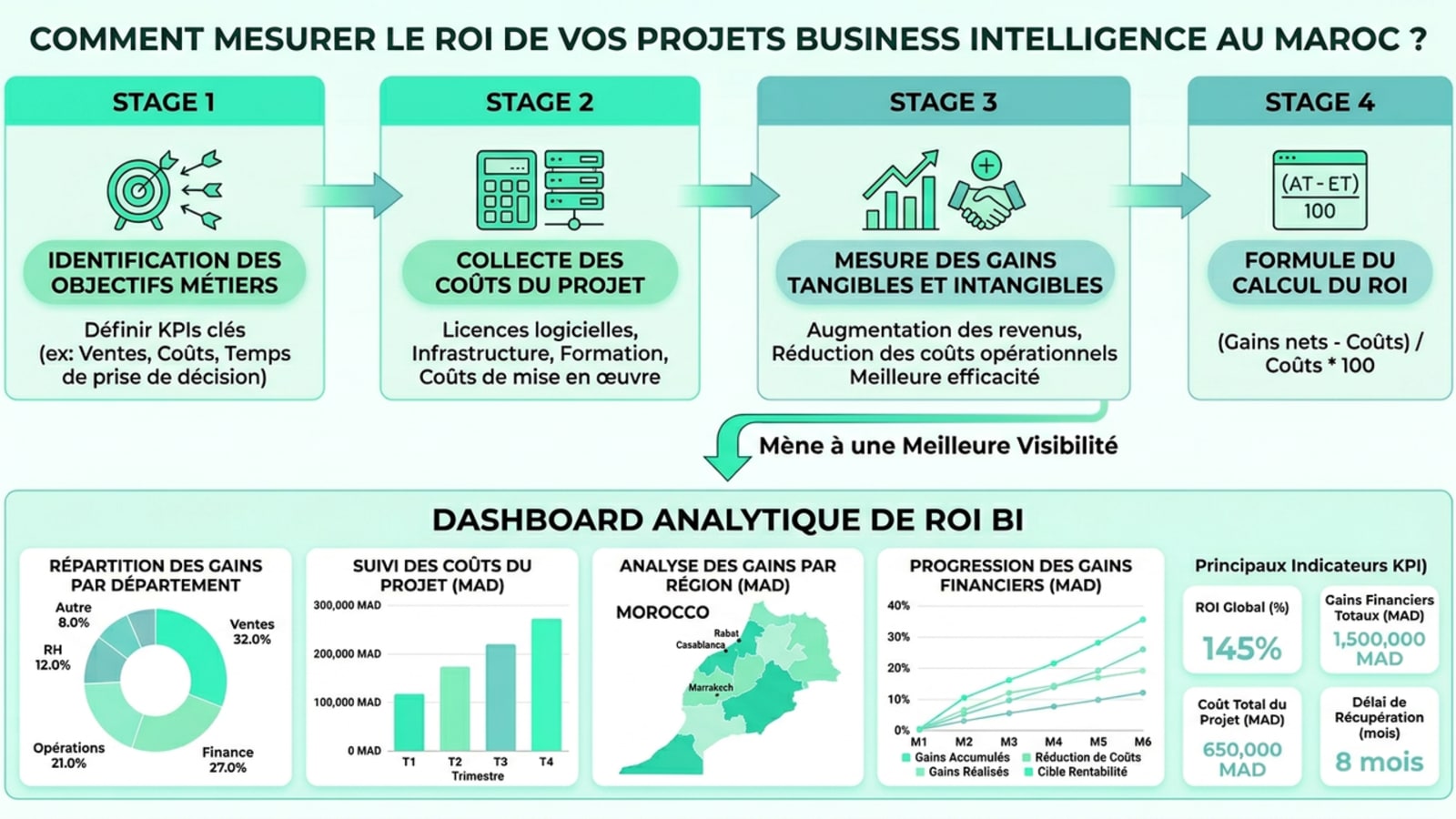
The ROI of a Business Intelligence project in Morocco is measured across 3 pillars: reduction in reporting time (40-80%), improved decision-making accuracy, and direct financial gains identifiable within the first 6 months.
# How to Measure the ROI of Your Business Intelligence Projects in Morocco
This is the question that every Moroccan executive eventually asks their CIO or data partner: what is the actual financial return on all of this? Business Intelligence represents a significant investment, and it is only natural to expect a measurable return.
The good news is: BI ROI is measurable. Here is how to calculate it and, more importantly, how to maximize it.
Why BI ROI is Challenging to Measure
The difficulty lies in the fact that BI generates value in several different ways—some directly quantifiable, others more indirect.
Reducing the time spent on reporting is directly quantifiable. If your teams used to spend 3 days a month consolidating reports and now only spend 2 hours, the gain can be calculated directly in payroll costs.
Improving decision quality is harder to isolate. If your sales director makes better decisions regarding sales force allocation thanks to a BI dashboard, the resulting revenue growth cannot be entirely attributed to BI alone.
Categories of Benefits to Measure
Operational gains are the easiest to quantify. These include reduced reporting time, automated data consolidation, and faster anomaly detection. These gains are measured in hours saved and costs avoided.
Commercial gains stem from better decisions regarding pricing, product portfolios, sales resource allocation, and customer retention. They are measured through revenue growth, profit margins, and retention rates.
Risk management gains are particularly relevant for banks and insurance companies, but also for any business with significant exposure to credit or operational risk.
A Practical Framework for Calculating ROI
To calculate the ROI of your BI project, start by listing all costs: software licenses, cloud infrastructure, integration and development costs, user training, maintenance, and support.
Next, quantify the benefits identified with your business teams before launching the project. How many man-days are currently dedicated to reporting? What is the cost of a poor sales allocation decision? What would be the value of a 10% reduction in churn rate?
ROI is then calculated by dividing the sum of annualized benefits by the sum of costs. A well-designed BI project typically achieves a positive ROI within 6 to 18 months.
How to Maximize the ROI of Your BI Project
Starting with high-impact, low-complexity use cases is the most effective strategy to quickly demonstrate value and build internal buy-in.
Involving end-users from the dashboard design phase is essential. A dashboard that directly answers the daily questions of a sales director will be used. A dashboard designed by IT without business input will eventually be abandoned.
Measuring and regularly communicating the realized benefits maintains team engagement and justifies future investments. Many BI projects deliver real benefits that are never formalized or communicated, which creates doubt about their actual value.
At Data Scale Business, we help our clients define clear success metrics before starting any project and track them throughout implementation. This is an integral part of our methodology and how we concretely demonstrate the value created for each client.