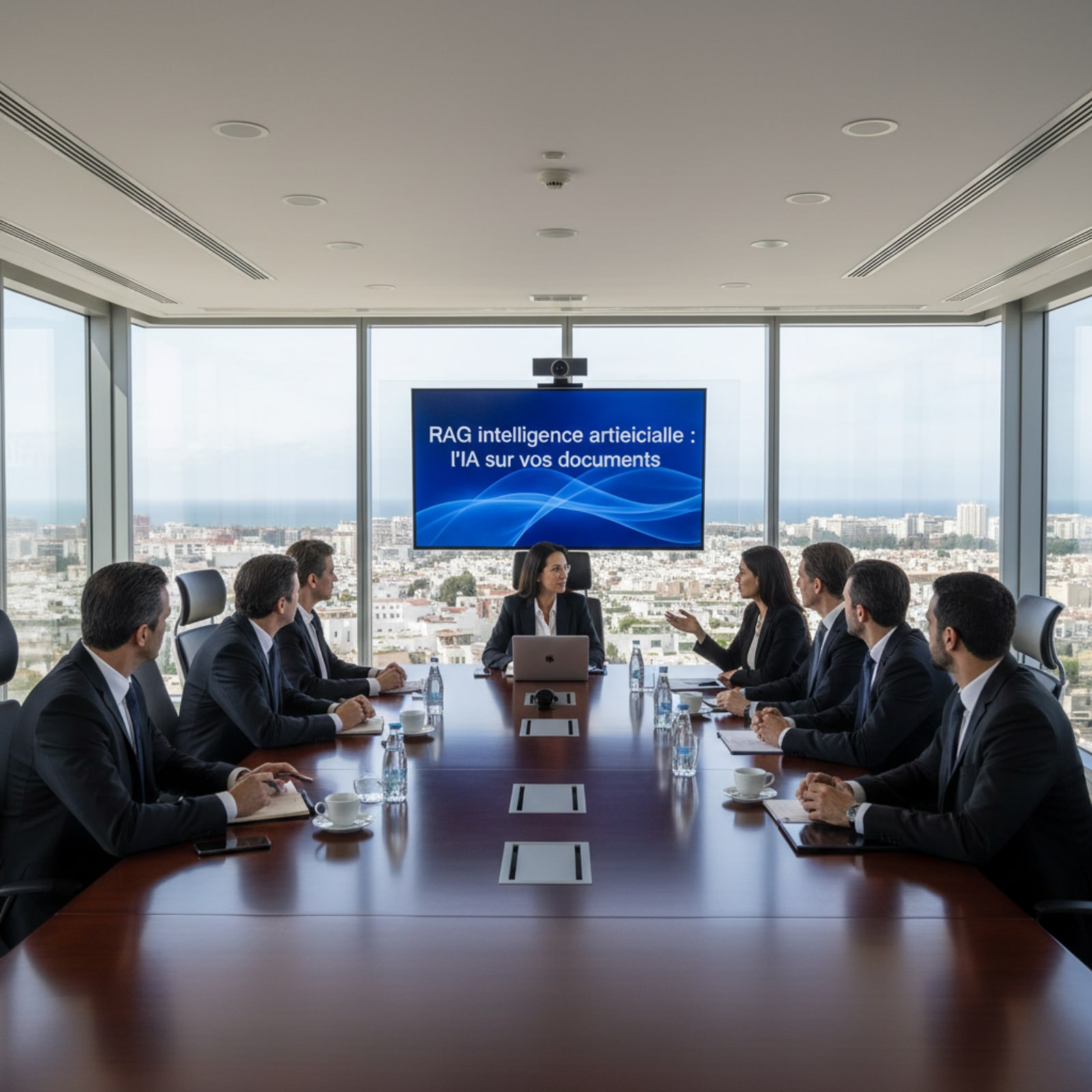
RAG (Retrieval-Augmented Generation) is an artificial intelligence architecture that connects a language model to a company's internal document database. Instead of retraining the AI, RAG searches for relevant paragraphs in your documents, integrates them into the user's prompt, and then asks the AI to write a reliable, sourced response, thereby preventing hallucinations.
In offices across Casablanca, from the Marina to Agdal, a scenario plays out every day. A CFO or an HR director asks a mainstream generative artificial intelligence tool to analyze an internal audit report or a Moroccan collective bargaining agreement. The response obtained is often disappointing, sometimes completely made up. The tool confuses local legislation with that of other countries or ignores the company's sector-specific realities. To harness the power of large language models without compromising the confidentiality and accuracy of your data, one technology has now emerged as the industry standard: RAG artificial intelligence, or Retrieval-Augmented Generation.
Why a Generalist Model Knows Nothing About Your Company
The most famous language models were trained on billions of public web pages. They possess an encyclopedic general knowledge, but they know nothing about what makes your organization valuable and unique. They do not know your purchasing procedures, your negotiated preferential rates with suppliers in the Tangier Med free zone, or the latest amendment to your group insurance contract.
When an employee asks a highly specific question about an internal document, a generalist model tries to fill in the blanks by extrapolating. This is what engineers call hallucination. The artificial intelligence then formulates a perfectly structured, highly convincing, but factually incorrect response. For a business, this risk of error is unacceptable. Furthermore, sending strategic documents to external servers poses major sovereignty and regulatory compliance issues regarding CNDP guidelines in Morocco.
The Three-Step Principle of RAG
RAG artificial intelligence technology solves this problem by acting like an assistant who opens the right binder before answering your question. Instead of asking the AI to memorize everything, we provide it with direct access to a structured AI knowledge base.
The first step is retrieval. When a user asks the internal AI assistant a question, the system does not immediately query the language model. It first performs an ultra-fast semantic search within your document database to identify the precise paragraphs containing the answer.
The second step is integration. The system extracts these relevant paragraphs and packages them with the user's initial question. This creates an ultra-targeted, secure, and temporary context.
The third step is generation. The language model receives this package containing the question and the document extracts. Its role is then strictly limited to reading this reliable information to write a clear, fluid, and fully sourced response. The AI no longer guesses; it synthesizes.
Document Quality Drives Response Quality
The success of a RAG artificial intelligence project relies on a fundamental principle of data engineering: garbage in, garbage out. Connecting an AI to its documents requires rigorous data preparation work.
Moroccan companies often have thousands of scanned PDF files, handwritten meeting minutes, or complex Excel spreadsheets in heterogeneous formats. Before configuring the AI assistant, it is essential to clean and structure this knowledge base. This involves segmenting long documents into coherent blocks of information, converting document images into usable text using high-performance optical character recognition tools, and classifying metadata to facilitate targeted semantic search.
At Data Scale Business, we find that the data preparation phase represents nearly 70% of the effort in a successful internal AI assistant project. An outdated or poorly structured document will inevitably lead the AI to deliver incorrect information to your teams.
Limitations and Typical Mistakes
Implementing a RAG artificial intelligence system involves classic pitfalls that decision-makers must anticipate. The first mistake is believing that simply dumping thousands of loose files into a shared folder is enough for the AI to become omniscient. Without data governance, the assistant will get lost in successive versions of the same document.
The second limitation concerns access rights management. If an employee asks the assistant about the company's salary grids, the system must not extract this confidential information unless the user explicitly possesses the required clearances. Configuring an effective RAG requires integrating security and filtering rules directly at the semantic search level.
Finally, the lack of a user feedback mechanism is a common mistake. An AI assistant must be continuously evaluated by business teams to adjust search algorithms and correct language biases over time.
What an Internal Assistant Costs in Practice
Deploying an internal AI assistant based on the RAG architecture represents an investment that must be evaluated against operational productivity gains. For a mid-sized organization in Morocco, the overall cost breaks down into three main budget items.
The first item is infrastructure and initial development. It encompasses setting up the vector database, connecting to the company's data sources, and creating the user interface. The second item relates to computing costs and the consumption of language models, which are often billed based on usage in the form of text tokens.
The third item, often overlooked but crucial, is change management and application maintenance. Training employees to write effective prompts and regularly updating the knowledge base ensures the tool's long-term viability. The time savings measured among our clients, particularly in searching for contractual clauses or summarizing technical reports, generally allow the investment to be amortized in less than six months.
To succeed in this transition toward a data-driven organization, guidance from data engineering and artificial intelligence experts is a key success factor. The teams at Data Scale Business design and deploy tailor-made RAG architectures, adapted to the security and efficiency requirements of the region's economic leaders.