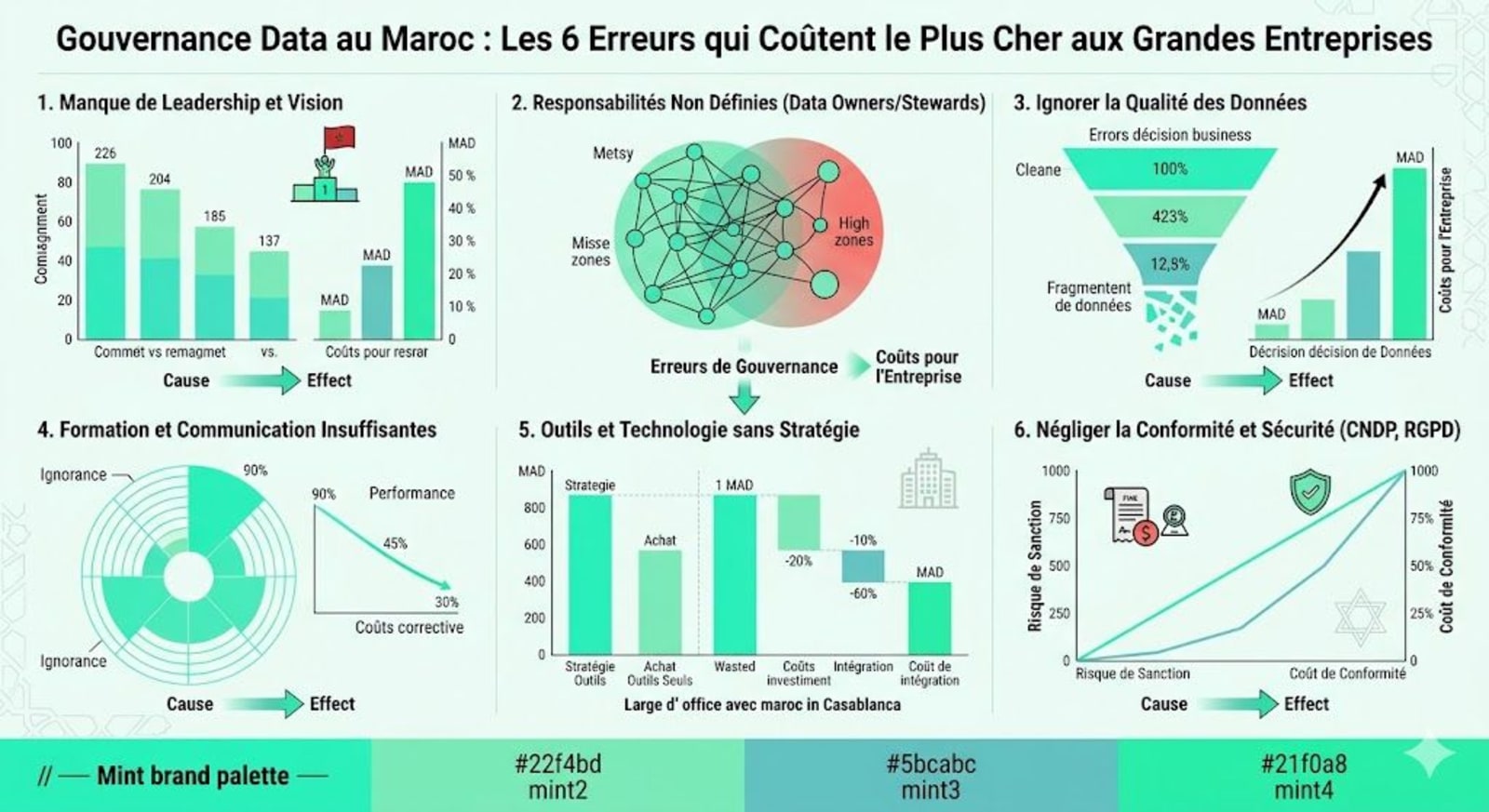
Data governance in Morocco involves defining who is responsible for data, how it is collected, stored, and used. The 3 most costly mistakes are the absence of data owners, disconnected data silos, and a lack of a data catalog.
The Data Project That Delivers Wrong Numbers
A large Moroccan group invests two years and several million dirhams in a data transformation project. The dashboards are delivered. They are beautiful, accessible, and well-designed. Executive management consults them for three weeks.
Then, the finance teams point out that the displayed margin figures do not match what their accounting department produces. The sales teams notice that customer data is incomplete for certain regions. The HR teams find that the displayed headcount includes employees who left the company six months ago.
The project is a technical success. It is operationally unusable.
This scenario regularly repeats itself in Moroccan companies that invest in data without building the governance required to make this investment sustainable over time.
What Data Governance Really Means
Data governance is the set of rules, processes, roles, and responsibilities that define how an organization's data is produced, validated, stored, shared, and used.
It is not an IT project. It is an organizational project that involves business units just as much as technical teams.
A company with good data governance can clearly answer simple questions. Who is responsible for customer data quality? What is the official definition of revenue in our organization? When sales data from the CRM system and the ERP yield different results, which one is the source of truth?
In the absence of governance, these questions have no answers. And without answers, every department produces its own version of reality.
Mistake #1: Confusing Governance with an IT Project
The first mistake is delegating data governance entirely to the IT department (DSI).
IT can build the tools, data catalogs, and quality pipelines. It cannot decide what constitutes an active customer, how the margin rate is calculated, or which business rule prevails when two systems show different figures.
These decisions belong to the business units. Data governance is an executive management topic before it is a technical one. Companies that succeed in their governance programs are those where the sponsor sits at the executive committee level, not the IT project manager level.
Mistake #2: Failing to Appoint Data Owners
In most Moroccan organizations we audit, no one is formally responsible for the quality of a specific dataset.
Customer data vaguely belongs to the sales department. Financial data vaguely belongs to the finance department. HR data vaguely belongs to the HR department. But when a data point is incorrect, no one feels responsible for fixing it.
Data governance requires appointing Data Owners for each critical data domain. These are specifically designated individuals with explicit responsibility for the quality and consistency of data within their scope. This role is not honorary. It must be written into their objectives and evaluated.
Mistake #3: Launching a Data Catalog Without Maintaining It
The data catalog has become a must-have for governance projects. It is the tool that references all the organization's data, its definition, source, owner, and quality.
The problem is that many companies invest in a catalog tool, spend three months configuring it, and then lack the resources or discipline to populate and keep it up to date.
An abandoned data catalog is worse than no catalog at all. It creates a false sense of control and misleads users regarding the reliability of the information it contains.
The rule we systematically apply: only reference in a catalog what the organization is capable of keeping up to date. Start small, maintain rigorously, and expand progressively.
Mistake #4: Neglecting Data Quality at the Source
Data governance is often perceived as cleanup work that happens after collection. This vision is fundamentally incorrect and expensive.
Cleaning data downstream from a system that produces it poorly is an endless task. For every data point corrected at the output, ten new incorrect data points enter the system. It is a bottomless pit.
True data governance acts at the source. It defines entry rules in operational systems, trains the users who populate these systems, and sets up automated controls that block or flag non-compliant data at the moment of creation.
This work is less visible than building a beautiful dashboard. It is infinitely more foundational for long-term decision quality.
Mistake #5: Ignoring the Regulatory Dimension
In Morocco, Law No. 09-08 on the protection of personal data imposes specific obligations on the collection, storage, and use of personal data. The European GDPR also applies as soon as an organization processes data of European residents.
Many Moroccan companies build their data architectures without integrating these constraints from the start. They later discover that certain planned use cases are legally impossible, or that their architecture requires costly modifications to achieve compliance.
Data governance must integrate the regulatory dimension as a design constraint, not as a post-hoc compliance check. This means mapping personal data from the start, defining the legal bases for its processing, and building the consent and deletion mechanisms required to respect individual rights.
Mistake #6: Trying to Govern Everything at Once
The sixth mistake is poorly calibrated ambition. Some organizations launch data governance programs that aim to cover all data domains, all systems, and all group entities simultaneously.
These programs run out of steam before producing any tangible results. They mobilize considerable resources for months without actually improving the quality of any data.
Data governance is built by priority. Identify the two or three data domains that have the greatest impact on strategic decisions. Build solid governance around this restricted scope. Demonstrate the value. Then, expand progressively.
LeBonCoin, with whom we worked on their data governance program, perfectly illustrates this approach. The initial scope was deliberately limited. The results achieved within this scope built the trust and legitimacy needed to expand the program.
Where to Start Concretely
If you recognize several of these mistakes in your organization, here are the first three actions to take.
The first is to conduct a data maturity audit. This audit maps your data sources, assesses their quality, identifies key consistency issues between systems, and establishes a prioritized list of governance initiatives to launch.
The second is to appoint a Data Steward for each critical business domain. This does not need to be a full-time position at first. It is a formal responsibility held by someone who understands the business domain and works in coordination with technical teams.
The third is to choose a high-impact initial use case and build exemplary governance around this scope. The visible success of a first initiative is the best argument to convince other stakeholders of the importance of this work.
Conclusion
Data governance is not a glamorous topic. It does not generate spectacular dashboards or impressive demos. It does not make the headlines of tech conferences.
But it is the absolute prerequisite for the sustainable value of any data investment. Without it, Business Intelligence projects produce figures that no one believes. ETL pipelines transport data that no one validates. Artificial intelligence models train on data of unknown quality.
Moroccan companies that seriously invest in their data governance today are building a competitive advantage that their competitors will take years to catch up with.