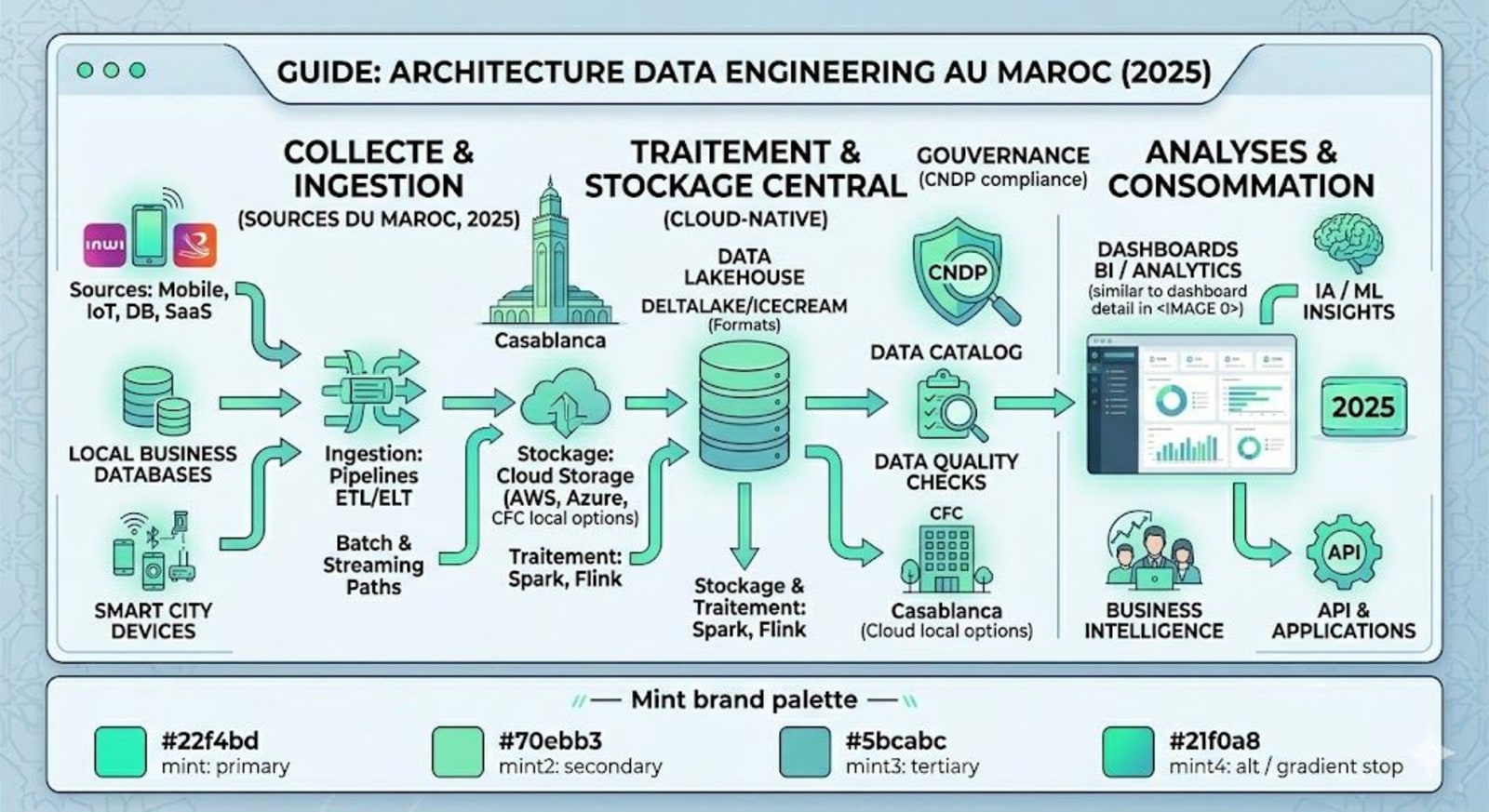
Data Engineering in Morocco involves designing robust data pipelines that connect ERPs, CRMs, and Excel files into a unified architecture, enabling reliable, real-time analytics for decision-makers.
# Data Engineering in Morocco: Building Your Data Architecture in 2025
Your data exists. It is in your ERP, your CRM, your Excel files, and your business applications. The problem is not a lack of data. It is that these data sources do not talk to each other, are unreliable, and are impossible to analyze effectively.
This is exactly the problem that Data Engineering solves. In Morocco, companies that have invested in their data architecture are gaining a significant competitive edge.
What is Data Engineering?
Data Engineering is the discipline of designing, building, and maintaining the infrastructure and pipelines that allow data to flow, be transformed, and be made available for analysis.
If Business Intelligence is the dashboard your Sales Director looks at, Data Engineering is the invisible plumbing that ensures the numbers on that dashboard are accurate, up-to-date, and complete.
Without solid Data Engineering, there is no reliable BI. It is as simple as that.
Data Challenges Specific to Moroccan Companies
Moroccan businesses face unique data challenges. Many rely on legacy systems imported 10 or 15 years ago that do not communicate with each other. Data is often stored in multiple languages—French, Arabic, and sometimes English—which complicates transformations.
Data maturity also varies widely across sectors. Banking and telecoms are years ahead of retail or manufacturing. In SMEs, it is not uncommon to find entire processes managed solely in Excel with zero traceability.
Components of a Modern Data Architecture
A modern data architecture relies on several layers working together.
The **ingestion layer** is responsible for collecting data from all company sources: SAP or Odoo ERPs, Salesforce or Microsoft Dynamics CRMs, partner APIs, flat files, and web data. Each source requires a specific connector and an adapted ingestion strategy, whether real-time or batch.
The **storage layer** determines where and how data is kept. Options range from traditional Data Warehouses like Snowflake or BigQuery to more modern Data Lakehouses that combine the cost-effective storage of a Data Lake with the analytical capabilities of a warehouse.
The **transformation layer** is where raw data becomes usable data. This is where duplicates are removed, formats are standardized, and business rules are applied. Tools like dbt have become the industry standard for this step.
The **consumption layer** exposes the transformed data to BI tools, data scientists, and business applications.
Data Warehouse vs. Data Lakehouse: Which to Choose in Morocco?
This is the question our clients ask us most frequently. The answer depends on your data maturity and your ambitions.
The **Data Warehouse** is a proven solution, ideal for companies with well-defined analytical needs and primarily structured data. Snowflake and BigQuery are cloud market leaders and fit the Moroccan context perfectly.
The **Data Lakehouse** is better suited for companies with large volumes of unstructured data, machine learning needs, or those wanting a highly flexible architecture capable of evolving rapidly. Databricks is the benchmark in this segment.
For a Moroccan SME starting its data journey, a well-designed cloud Data Warehouse is almost always the right choice. For a large corporate group or a bank, the Lakehouse architecture deserves serious consideration.
Data Pipelines: The Heart of Data Engineering
A data pipeline is the path data travels from its source to its analytical destination. Building reliable pipelines—that run even when a source is temporarily unavailable, alert on anomalies, and document applied transformations—is the daily job of a Data Engineer.
Tools like Apache Airflow, Prefect, or Dagster allow teams to orchestrate these pipelines and ensure they execute in the right order at the right time.
How Much Does a Data Engineering Project Cost in Morocco?
The cost of a Data Engineering project depends on the complexity of your data ecosystem, the number of sources to integrate, and the chosen target architecture.
A first project to set up a cloud Data Warehouse with 5 to 10 data sources can be completed in 3 to 6 months. The cloud infrastructure then represents a recurring monthly cost, typically ranging from a few thousand to tens of thousands of dirhams (MAD) depending on volumes.
The investment is quickly amortized by gains in analytical productivity and the reduction of errors associated with manual consolidations.